drghirlanda

Computational behavior theory and cultural evolution

Swede Surrender

Italian politics has never been a model to follow. Things did not improve when, in the early 1990’s, the 50 year opposition between the Christian Democratic Party and the Italian Communist Party came to an end because of corruption scandals (mostly affecting the first party) and of communism going out of fashion (mostly affecting the second one). The current political situation is of a Prime Minister who has repeatedly narrowly escaped jail (often through his own tweaking of the law) and of opposition parties who have proved unable to lift Italy out of its historical inefficiency.

I think it is time for Italians to acknowledge that a radical intervention is needed. My idea is: let Italy become a colony of Sweden. It would be a win for both countries. Italians would enjoy efficient administration and sane public policies, and the Swedes would benefit from having a base in a country with better climate and food.

Are you in favor?

Avocado Gelato

Ingredients:

  • 2 ripe avocado – the softer the better
  • 2 cups (475 ml) whole milk
  • 2 tbsp corn starch
  • 1 lemon
  • 1/4 cup (50 g) of sugar
  • a pinch of baking soda

Directions:

Cut 2 or 3 strips of lemon peel from the lemon and put the to boil in a pan with the 1.5 cups milk and sugar over medium heat. Grate the rest of the lemon peel into the milk. While the milk heats up, dissolve the corn starch in 1/4 cup milk (better in a cup with a wisk) and add it in the pan. Simmer for 2-3 minutes. Turn off heat and remove the lemon peel. As the milk cools, peel the avocados and cut them into pieces. Purée them in a food processor or blender with 1/4 cup milk. Add them to the milk, add a pinch of baking soda, and wisk well. Put the mixture into a gelato machine.

Notes:

This recipe is modified from this one. I exploit more of the lemon and I use 1/3 of the sugar (my standard rule for U.S. frozen dessert sources). The pinch of baking soda adds a hint of “cake batter” flavor. A food processor is better because the avocados tend to get stuck in a blender; this can be avoided by adding some milk). The flavor is much better when the avocados are very ripe (even browning), but the color may be somewhat compromised.

Confidence Intervals

I have not found an accepted way to write asymmetrical confidence intervals. Two possibilities are rendered in the image below. I personally prefer the second one, which uses the standard ± sign already in use for symmetrical confidence intervals, simply splitting the confidence interval boundaries into two stacked numbers.

Another possibility is to write directly the upper and lower limits:

Rogue

The next time someone claims to be “going rogue,” they should first look up the meaning:

From the Merriam-Webster Online Dictionary:

Main Entry: rogue
Pronunciation: \ˈrōg\
Function: noun
Etymology: origin unknown
Date: 1561

1 : vagrant, tramp
2 : a dishonest or worthless person : scoundrel
3 : a mischievous person : scamp
4 : a horse inclined to shirk or misbehave
5 : an individual exhibiting a chance and usually inferior biological variation


From the Online Etymological Dictionary:

rogue
1561, “idle vagrant,” perhaps a shortened form of roger (with a hard -g-), thieves’ slang for a begging vagabond who pretends to be a poor scholar from Oxford or Cambridge, perhaps from L. rogare “to ask.” Another theory traces it to Celtic (cf. Bret. rog “haughty”); OED says, “There is no evidence of connexion with F. rogue ‘arrogant.’ ” Rogue’s gallery “police collection of mug shots” is attested from 1859.

Semester på vinter!

In Swedish, winter is not referred to as the cold season. It is den mörka årstiden – the dark season. For a tourist, snow-covered Stockholm around Christmas is a fairy tale, but to live and work with 6 hours of daylight is not everyone's piece of cake. Winter depression is estimated to affect 5-10% of the Swedish population (compare to about 4% for diabetes). Many more people do not meet criteria for a clinical depression, but still feel depressed mood and fatigue to varying degrees (Katia's and Anna's experiences).

Den mörka arstiden's toll on Swedes is acknowledged explicitly or implicitly in many ways. There are several school breaks during the winter so that families can travel (traditionally, they went skiing even further up north, nowadays Thailand and the Canary Islands are the preferred destinations). Working hours are slightly longer in winter than in the summer, so that the brief summer can be enjoyed more fully (the workday is officially set at 8 hours and 10 minutes between mid-September and mid-May, and at 7 hours and 30 minutes the rest of the year). And so on.

I think there is a better solution: reverse summer and winter vacation so that there are two-three months of vacation in winter and one in summer. This would enable people to escape the darkness. Many people effectively do this already, thanks to the fact that work schedules are often very flexible in Sweden. There are, however, important exceptions, like schools and universities. The majority of the population is affected by school and academic schedules: kids in school, their parents, University students, and anyone who works in education. These persons cannot take vacation when they like. Those among them who suffer from light deprivation cannot take vacation when they would need it for their health. Some people are so disabled in the winter that they have to take extended sick leave, which is paid by the State, when they could on vacation (and in good health) on their own budgets.

If you live in Sweden, and are interested in reversing winter and summer breaks, drop me a line at dr.ghirlanda@gmail.com. I just saw a documentary about Howard Zinn, so I believe that if we organize we can do anything. And remember, Sweden switched from left-hand traffic to right-hand traffic overnight, on September, 3rd, 1967.


Catching Extra Time

Here I am on the Riva di Ca' di Dio in Venice visiting the 53rd International Art Exhibition. The black shirt and the tie entitle me to comment on the artworks with authority.

The shiny cube I'm leaning on is a showcase for Nikola Uzunovski's My Sunshine project. Nikola, an applied artist, wants to improve the quality of life at northern latitudes (or deep mountain valleys). The problem with these places is that, although they may well be wonderful in all other respects, they get light for a rather short time in winter. In the best of cases, lack of sunlight makes you a bit sleepy, in the worst case it makes you clinically depressed.

Nikola's solution is a device that lengthens the day: a mirror that floats up in the sky, electronically controlled to shine the sun's image on an otherwise dark spot on earth.

How does it work? Simply, the device exploits the fact that up in the sky the day lasts longer than at the earth's surface – as shown in the diagram at left (please do not blame Nikola for that). The mirror, floating inside a helium filled balloon, reflects 90% of the afternoon rays onto the earth below creating a virtual sun.

My sunshine is a step toward bringing Italian climate to Swedish civilization – the Eden of humanity. Bringing Swedish civilization to Italian climate, unfortunately, remains a daunting challenge for artists and scientists alike.

A Fine Example of Sexism in Italian Divorce Law

In italy, a woman cannot remarry until 300 days after a divorce. This norm intends to avoid paternity disputes by making sure that, upon remarrying, a woman is not expecting a child from her previous husband. Such intent is apparent from the provisions, stated in the same law, that allow to cut the 300 days short if:

  • The woman proves she is not pregnant.
  • The woman proves that she did not legally live with the former husband in the 300 days after divorce.
  • The previous marriage has been terminated because of the sterility of either partner.

How many flaws can you find in behind this norm? I have found the following:

  1. A divorcing man is not required to prove that his former wife is not pregnant, hence the norm is sexist.
  2. The law assumes that a woman has sex only with her husband.
  3. The law assumes that a woman has sex with a man only if they live together.

All this makes the norm ineffective in its intent, i.e., preventing paternity disputes. The law was written around 1980, mostly by men born in the 1920s and 1930s. Those aging, somewhat sexist, democratically elected lawmakers could not anticipate that paternity tests would obsolete their hard work in a few years. While point 1 above is, in theory, sufficient to make the law unconstitutional in Italy, the law itself has not, apparently, been challenged in court, and thus stands as of today, August 20th, 2009.

I have been able to find other similar cases: Puerto Rico, Lousiana before 1970 (remarriage laws in the U.S.). Do you know of other similar legislation elsewhere?

Mind the Data!

Gapminder is a wonderful, public tool that lets you visualize current data and historical trends in many demographic, economic and social indicators. Do you want to know how life expectancy in the USA has developed compared to, say, Cuba and Qatar? Just go here and click Play (then come back here, please). Three rather different development paths toward the same life expectancy. Fantastic.

GapminderLog

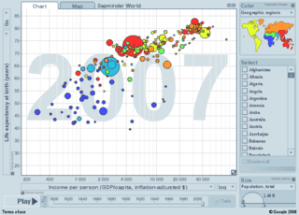
The image to the right is the first thing you see on gapminder. It shows
the relationship between income (horizontal axis) and life expectancy
(vertical axis) in countries throughout the world. Each circle is a
country and its size is proportional to the country’s inhabitants (the
big red circle is China, the big blue one India).
There is clearly a positive relationship.

In a TED lecture, Gapminder founder Hans Rosling uses this image to argue that focusing on economic growth is the best thing to do to improve life expectancy in developing countries (the low-income, short-life blue dots in the image represent Africa). I think this is true, but the statement should be qualified. The catch is that the horizontal dimension does not show raw income, but orders of magnitude of income – notice how the distance between, say, $200 and $400 is the same as between $2000 and $4000.  This is called a logarithmic scale and is used for better display of certain patterns.

If you display income dollar-for-dollar, as in the image on the right, the pattern looks a bit different. Now it shows clearly that a very small income, by Western standards, can be associated with a rather long life: people in big red China achieve a life expectancy of 73 years with under $5000 per year. And so do many other countries, like Vietnam (where under $2500 per year buy you 74 years of life) or Syria (74 years for $2200). Beyond this point – about 75 years and $5000 per year – additional income buys relatively little, as the fat yellow dot (the USA) says: 78 years for $42000 per year.

Thus there seems to be a lot to gain from economic development in very poor countries (Africa is blue), and relatively little to gain from further increase in income in moderately rich to very rich countries.

Animal and Hum(e)an homosexuality

A report that lesbian pairs are common in a Hawaiian Albatross colony (Young et al, Zuk & Bailey) is the latest finding on animal homosexuality to raise some media attention (Daily Telegraph, Wired, Times Online). Many people are afraid to find out that homosexuality exists in animals, and therefore is "natural," because what is natural is often deemed morally acceptable.

David Hume, making perhaps the most important point in the history of ethics, stated over 200 years ago that we should not argue about how the world ought to be based on how the world is. Yet research on animal homosexuality still brings people on the verge of this error, by triggering the question: is it "natural"?

Hume himself did not speak enthusiastically of the "shameful and unnatural lusts […] which, by our law, […] justly expose the offender to be punished by death" (Commentaries on the Law of Scotland). He excused, however, the "Greek loves" as arising "from a very innocent cause, the frequency of the gymnastic excercises" (An Enquiry Concerning the Principles of Morals, Schmidt's summary of Hume's moral ideas).

Hume thus did not follow his own advice against confusing what is natural and what is moral, nor do many people today. The "unnaturalness" of homosexuality should not figure in discussions of homosexuality and human society. Lesbian Albatrossess are an interesting biological phenomenon, but should not burden us with moral dilemmas.

And from my neck so free
The Albatross fell off, and sank
Like lead into the sea
.

Eurolocalism

European Parliament elections, taking place these days, are a perfect example of the constant struggle between continental cooperation and localistic parochialism in the European Union. Europeans are called to vote for their representatives in "the only supranational institution whose members are democratically
elected by direct universal suffrage
," which "represents the people of the
Member States
" (source). Yet they can only vote for citizens of their own country (or the country of residence, if living abroad). The implicit assumption is that someone can be fairly represented only by her or his own nationals (or those who live nearby), which is exactly the kind of localistic thinking that the EU should strive to overcome. Personally, I would be glad to be able to vote for non-Italian politicians.